DIY Outdoor Kitchen Island Cost: Build a Grill Island or Griddle Station?
A 36 in griddle station costs about $730 to $1,040 in materials to build. Finished outdoor kitchen islands run $3,743 to $8,999. Where the money goes.
If you want an outdoor cooking setup with a built-in look, there are two realistic DIY routes, and their costs are very different. A 36 in griddle station, a low cabinet that holds a flat-top griddle with a prep counter on each side, costs about $908 in materials, with a realistic range of $730 to $1,040. A full grill island, with cabinet boxes, a built-in grill head and a thick stone-look counter, is a much bigger project, and finished outdoor kitchen islands of that kind from catalog retailers and showrooms run about $3,743 to $8,999. Finished griddle stations and cabinets run about $649 to $2,499.
We can give a firm materials number for the griddle station, because its plans price every board and screw. For the island, the total depends on choices you make (counter material, door and drawer layout, grill head, length), so this article explains what drives the cost instead of printing a single figure we cannot support.
All materials estimates are at typical US home-center prices and vary by region.
Route one: the griddle station
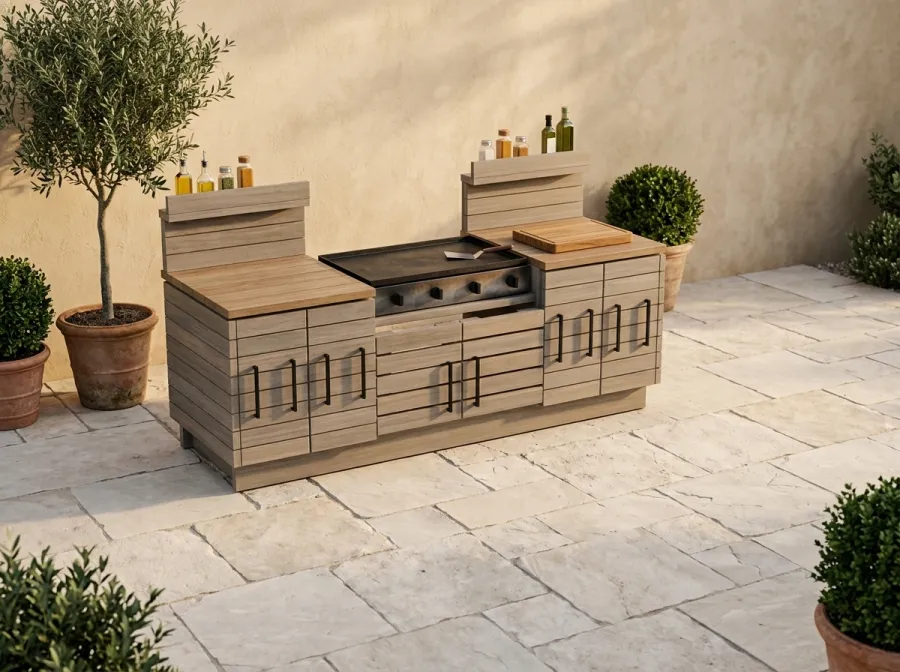
Our Griddle Station plans cover a low gray-washed cabinet with a center bay that holds the griddle level with the counter, a plank prep counter on each side and slat doors with black pull bars all along the front. Here is the 36 in version, grouped and rounded:
| Category | What is in it | Estimated cost |
|---|---|---|
| Lumber | 38 boards of 2x4 and 8 of 2x6, outdoor-rated | $470 |
| Fasteners and glue | Exterior structural and deck screws, exterior wood glue | $84 |
| Hardware | Flag or strap hinges, bar pulls, catches, shelf brackets, tank strap, hooks, pads | $154 |
| Heat protection | Cement board or galvanized sheet metal for the griddle bay | $18 |
| Finish | About 9 quarts of exterior stain or paint, sandpaper | $180 |
| Total (36 in) | about $908 |
The 28 in version, for a smaller griddle, comes to about $880 (range $700 to $1,010). The difference is small because the cabinet is almost the same size: the 36 in station is about 8 ft 1 in long and the 28 in about 7 ft 5 in long, both 2 ft 9 in deep with 3 ft high counters.
The griddle itself is not in the estimate. You bring a cart griddle or buy one separately, and that purchase can be larger than the cabinet.
What costs money in a griddle station
Lumber is about half the bill, and the plan uses a lot of it: slat doors, plank counters and a framed carcass. Finish is the surprise at about $180, a fifth of the total. Everything outside needs sealing on every face, edge and end, and slatted designs have many edges.
Hardware is $154 because there are six doors. Black surface-mount hinges alone are about $72. You can compare black exterior flag hinges, black bar pulls and exterior door latches against the specifications in the plans.
Route two: the grill island
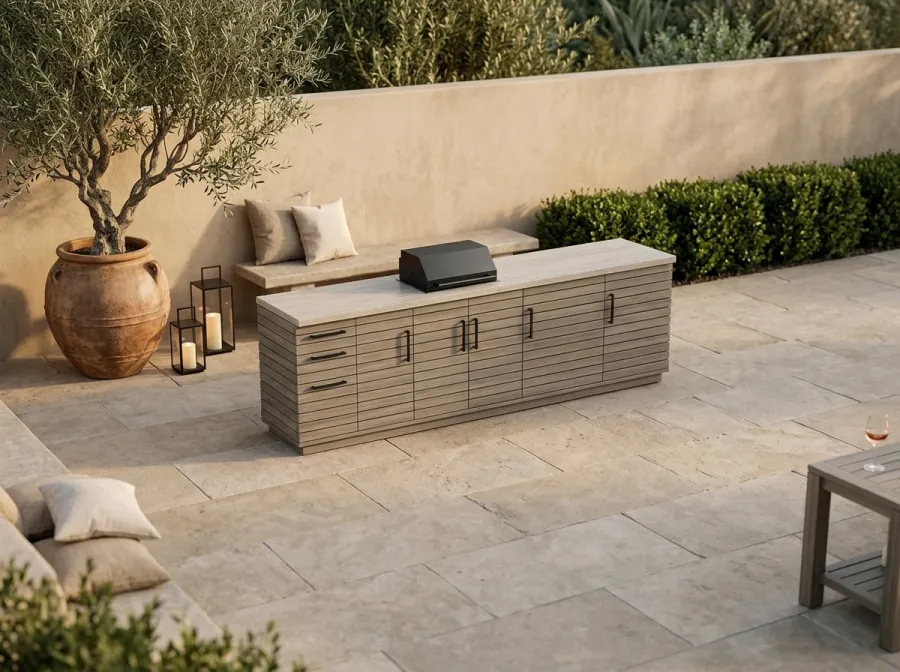
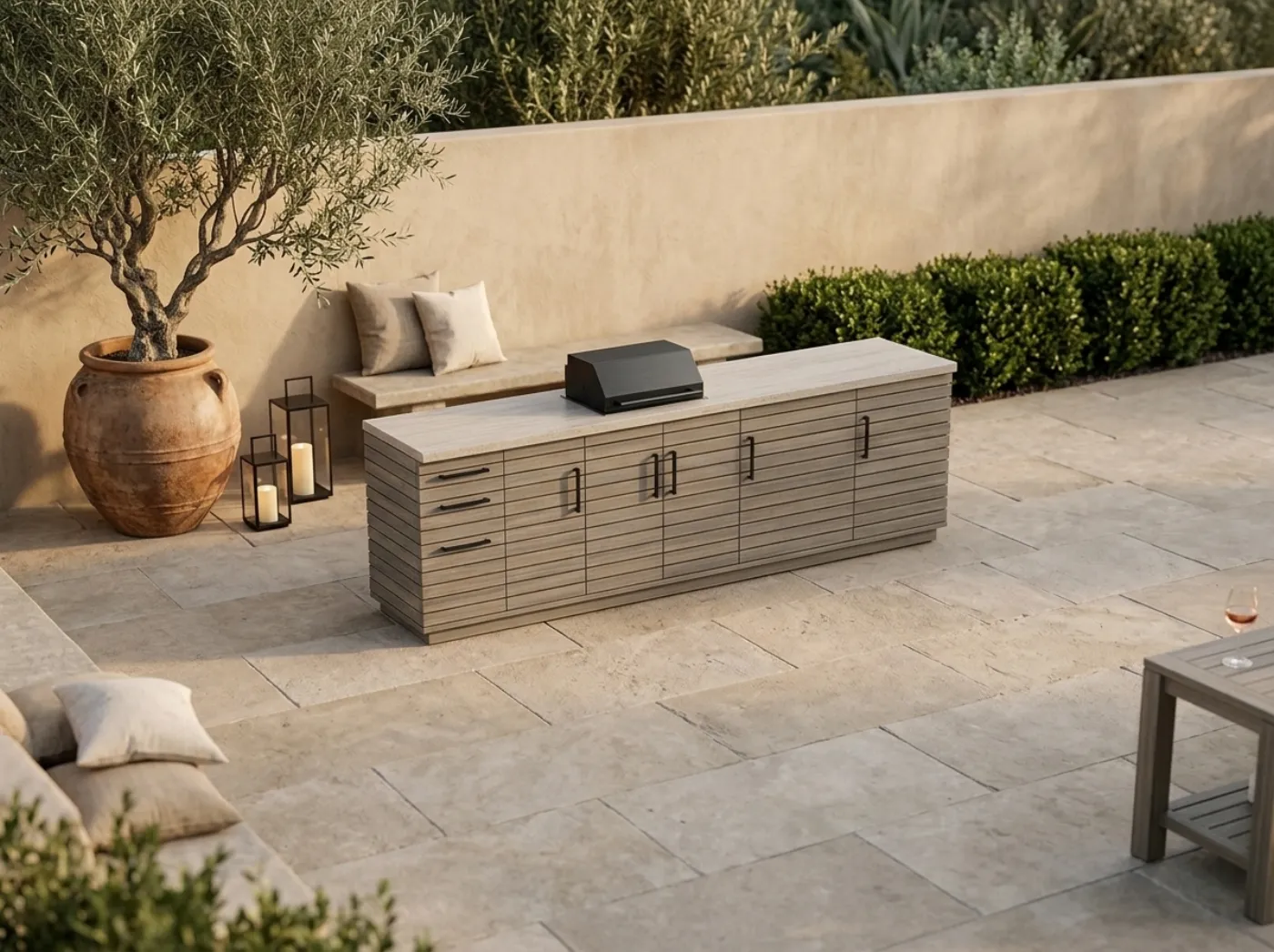
The Grill Island plans take a different approach. Two lengths come in one kit, 8 ft and 10 ft. The cabinet is flat-pack plywood boxes in only two sizes, a 24 in box and a 48 in grill box, clad in tight horizontal slats that look like gray-washed teak, with plain slatted doors and drawer fronts with black pull bars. The structure sits on a treated 2x4 plinth. The counter is thick and stone-look.
You choose several things yourself:
- For each 24 in box, a door, a three-drawer stack or a trash pull-out.
- A counter in poured concrete, tile over cement board, or a quartz remnant with a thick front edge.
- A drop-in or built-in grill head in an insulated jacket, or a cart grill that rolls into an enclosed bay with matching doors.
- Optional extras: a 12 in bar overhang on black steel brackets, an L-shaped return, and a simple modern pergola.
Each choice changes the price. A counter of poured concrete uses mix, forms and reinforcement. Tile over cement board uses board, thinset, tile and grout. A quartz remnant depends on what a fabricator has on hand. The grill is the other big variable: a built-in head is a purchase of its own, separate from the cabinet materials, and the cart-grill option lets you reuse a grill you already own. Because those choices span such a wide range, there is no honest single number. What the plans do give you is a computed shopping list for the 8 ft and 10 ft layouts, a weekend planner and a budget planner, so you can price your own version before you buy anything.
Build versus buy
What a finished island gives you. A delivered island or a modular outdoor kitchen arrives with doors, drawers and often a stone counter already installed. Some include appliances. A professional can handle utility connections, and the manufacturer provides a warranty. If your project needs gas lines, plumbing or electrical work, you will want licensed help either way.
What building gives you. Control over layout and finish, and a build that you can add to over time. The plans use only two box sizes, so you can lengthen or rearrange the layout without redesigning. For a griddle station, the saving is large: about $730 to $1,040 against $649 to $2,499 finished. At the cheaper end of finished stations, a store version can match the cost of the build. At the upper end, building is much cheaper.
The honest middle. For the full island, the savings can be significant because the retail range starts at $3,743, but they depend on your choices. If you pick a quartz counter and a premium built-in grill, you are spending what a good portion of the retail version costs, and the savings are mostly in cabinetry and labor. If you choose concrete or tile and a cart grill that rolls into the bay, you save far more.
What drives cost up or down
Wood choice
The griddle station estimate prices outdoor-rated 2x4 at about $1.20 per foot and 2x6 at about $1.68. Cedar and redwood cost more than pressure-treated stock in most areas. For a piece that stays outdoors and takes heat and moisture, a weather-resistant species and a sealed finish pay off.
Finish
The estimate carries 9 quarts of exterior stain and sealer. Buying by the gallon may lower the cost per quart. A weathered gray tone fits the look in the plans. Seal end grain thoroughly.
Heat protection
Heat is the one place not to economize. The griddle bay is lined with cement board or galvanized sheet metal at about $18. The island has an insulated jacket and a cement board liner. Cement board is inexpensive compared with the risk it addresses.
Pad and site
Neither plan includes a patio. Both assume a level, non-combustible surface, and the plans have a pad and local rules sheet. If you need to pour a slab or lay pavers, add that to your budget.
Casters
Locking swivel casters are an optional extra for the griddle station. Locking swivel casters rated 125 lb let you move the cabinet, but they are not priced in the $908.
The hard parts and how the plans handle them
Propane storage. In the griddle station, the doors under the griddle hide a propane tank in a vented cabinet: gaps between slats, a slot at the bottom and one at the top, the back left open, a hose pass-through to the griddle and a strap that keeps the tank upright. A propane tank hold-down strap is in the hardware list. Ventilation matters, so do not close the gaps.
Heat and fire clearances. Both plans have a safety sheet on clearances. Grill cutout sizes vary, so the island plans tell you to take the cutout spec, clearances and jacket requirements from your own grill manual rather than from the plans. Follow the manufacturer’s instructions for your appliance, and check local rules for fuel, venting and distance from structures. These are generic DIY plans, not engineered drawings, and they do not replace gas fitting by a qualified person or local building and fire rules.
Measuring the griddle. The griddle plans start with a Measure your griddle sheet, because bays are cut to the appliance.
The counter. The island’s thick stone-look counter is the heaviest element. The plans check the plinth, stretchers, deck and brackets against a stated load, but you must choose a counter that suits the base.
Long runs outdoors. Whatever you build will face sun and rain. Seal it, keep it off wet ground, and recoat on a schedule.
Time, tools and skill level
The griddle station is written for first-time builders who can follow flat-pack instructions and want a built-in look for much less. It takes about 15 to 16 hours of work over a weekend. You need a saw, a drill, a tape and a square. A pocket hole jig is useful but not required.
The island is for home builders comfortable with a circular saw, a drill and a level. It has 16 numbered steps per layout. The counter step may call for skills or help beyond woodworking.
Sizes available
Griddle stations come in 36 in and 28 in versions. The islands come in 8 ft and 10 ft, with options for a cart-grill bay, an L-shaped return, a bar overhang and a pergola.
Pricing your own island
Because the island has no single total, build the number yourself. Start with the plan’s shopping list for your length, then add the four decisions that sit outside it: the counter, the grill head or cart grill, any extras such as the bar overhang or pergola, and the pad if you need one. Get a quote for a quartz remnant from a local fabricator before you commit to it, since that is the price you cannot estimate from a home center. For concrete, price the mix, form material and sealer. For tile, price the cement board, thinset, tile, grout and sealer. Write each figure into the budget planner in the plans, and add a margin for the fasteners, finish and small hardware that always run over. Doing this before you buy any lumber takes an evening and tells you whether the island or the station is the right size of project for you.
Which should you build?
If you already own a cart griddle and want a handsome, practical home for it, build the station. It is a weekend, the materials are about $900, and you can add casters, a splash wall and a bottle shelf later. If you want the grill built in with real cabinet storage, the island is the better long-term project, but plan it as a larger investment and price your own version before you start. The build-cost hub compares many projects side by side.
Where to go next
The Grill Island plans cost $16.99 and run 118 pages. The Griddle Station plans cost $12.99 and run 71 pages. If you want both, the complete collection bundles every plan for $129. Whichever you choose, read the fire safety and venting sheet before you buy lumber.