Murphy Bed Hardware Explained: Lift Assists, Pivot Hinges, Latches and Legs
What hardware a DIY Murphy bed needs: pivot hinges, gas piston or spring lift assists, stop straps, latches and legs, with ratings by size and safety notes.
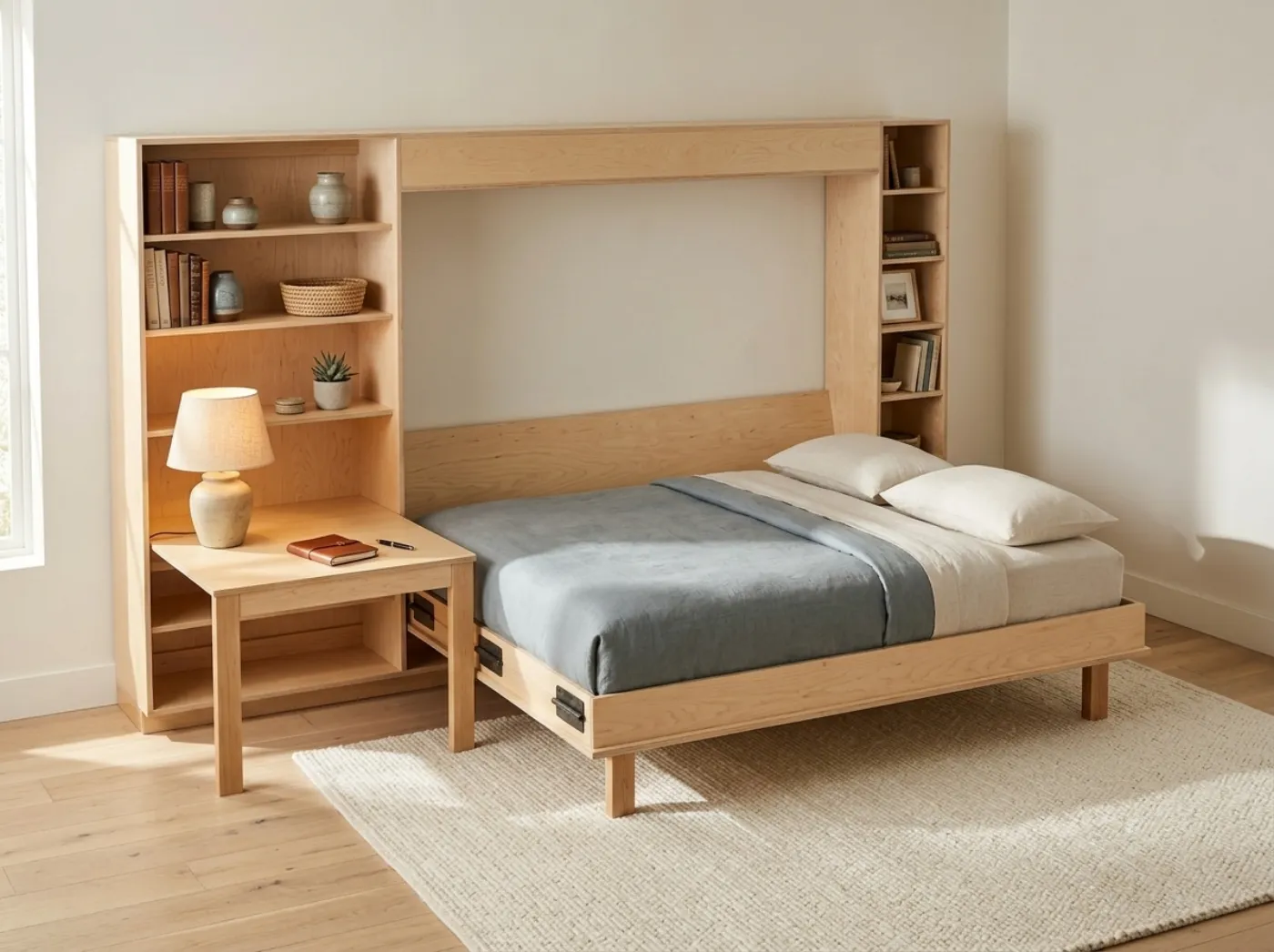
The cabinet of a wall bed is ordinary plywood and lumber work. The hardware is what turns a heavy box into a bed that one person can raise and fold away with a fingertip. Hardware is also where a DIY build needs the most care, because the parts carry real weight and move through an arc. This guide explains each component, how to size it, and how it fits into a side-tilt wall bed such as the one in the catalog.
Two types of wall bed
Wall beds come in two main arrangements. A vertical (end-tilt) bed pivots at the foot end and stores with the headboard facing up, narrow against the wall. A horizontal (side-tilt) bed pivots along its long edge and stores with its long side against the wall, so the closed unit is wider and not as deep. Each uses a different lift mechanism and mounting pattern.
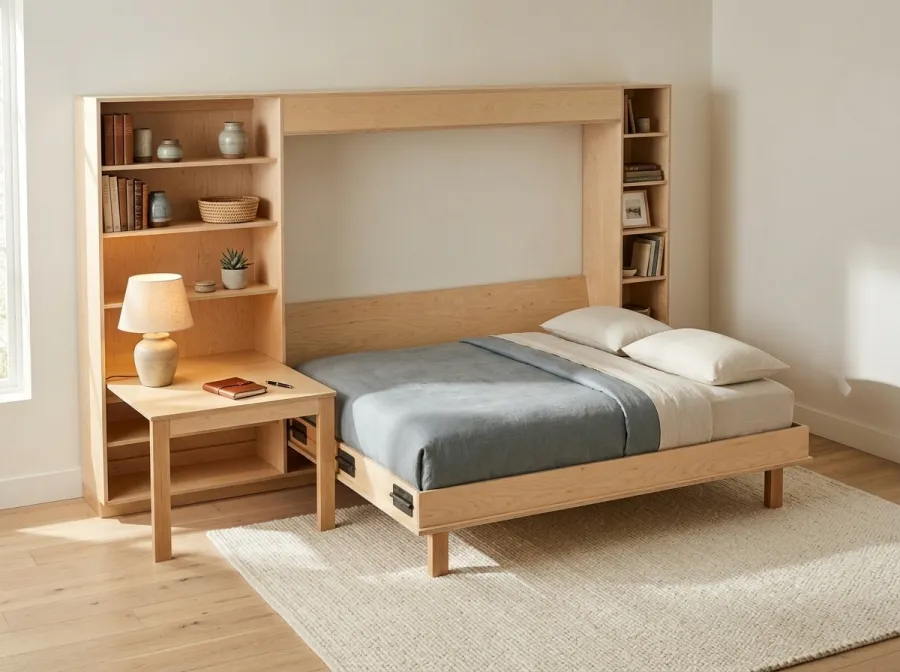
The Library Wall Bed is a horizontal, side-tilt design. The bed is a flat plywood box hinged along its long bottom edge: stored, it stands up behind a framed face, and folded down, it reaches 3 ft 4 in (twin), 4 ft 8 in (full) or 5 ft 2 in (queen) into the room, with two fold-out wooden legs under the foot. The closed unit is 1 ft 6 in deep and 7 ft tall, and 11 ft 1 in wide for twin and full or 11 ft 6 in for queen, because it includes a desk tower and a shelf tower on either side. The plan is open about hardware: you buy heavy-duty pivot hinges, a lift assist rated for the bed weight, stop straps and a latch, and the plans supply the weights, the ratings to look for and the torque the lift assist must hold.
The hardware at a glance
| Component | Job | Plan rating or note |
|---|---|---|
| Pivot hinges | Carry the bed on its hinge edge | 3 heavy-duty steel hinges, 500 lb each for twin and full, 600 lb each for queen |
| Lift assist | Balances the bed so it is easy to lift | Pair of gas pistons or spring mechanisms; 230 lb or more (twin), 320 lb or more (full), 370 lb or more (queen) |
| Stop straps or chains | Limit the swing to 90 degrees | 2, rated 300 lb |
| Closed-position latch | Keeps the bed shut | 2 heavy-duty positive-locking latches |
| Bed legs | Support the foot when open | Folding legs, hinged, with slide bolts or leg locks |
| Desk hinge | Hangs the desk leaf | 48 in continuous hinge, 300 lb or more |
| Mattress hold-down straps | Hold the mattress when upright | 2 webbing straps with buckles |
| Wall anchors | Tie the cabinet to the wall | Structural screws, 5/16 x 5 in, stud rated |
All the numbers above come from the plan’s materials lines, and you should follow the lines for the size you build.
Pivot hinges
The hinges carry the bed at its pivot as it swings from vertical to horizontal. They carry both the weight of the bed and the load of anyone who sits on the edge. Look for:
- Heavy steel, with full-length leaves that spread the load across several screws, and not decorative hinges.
- A stated load rating per hinge. The plan calls for three hinges at 500 lb each for twin and full beds and 600 lb each for the queen.
- Mounting holes for structural screws, and sufficient wood behind them.
Mount hinges only into solid framing members, as specified in the drawings. A heavy-duty strap hinge with generous leaves is easier to align than a small butt hinge. Pre-drill, and use the screws the hinge requires.
Lift assists: gas pistons and springs
A lift assist counterbalances the weight of the bed so that raising and folding it down takes light effort. Without one, a bed deck plus mattress is a very heavy lift and a very fast drop. There are two common kinds.
Gas pistons
A gas piston is a sealed cylinder that pushes outward with a fixed force. Pairs are mounted between the cabinet and the bed. They give a smooth, damped motion. Their force slowly declines over years, and they are slightly sensitive to temperature, so the bed feels different in a cold garage than in a heated room. Pistons are rated by force, so you need to choose a pair that matches the bed.
Spring mechanisms
A spring mechanism, either coil springs or torsion springs, stores energy as the bed is folded down and releases it as it rises. Many are adjustable, so you can tune the balance by changing tension. Springs are usually a little less smooth than gas, but they do not leak pressure, and they allow fine adjustment as mattress weight changes.
The plan accepts either: a lift assist for a horizontal (side-tilt) wall bed, rated for 230 lb or more for the twin, 320 lb or more for the full and 370 lb or more for the queen, using a pair of gas pistons or a pair of spring mechanisms and following the maker’s mounting chart. The rating is the bed load the mechanism is designed to balance, so a heavier mattress or added bedding pushes the requirement up.
Choosing and mounting
- Match the rating to the size. Do not use a twin kit on a full bed.
- Include everything on the deck. Weigh the mattress or use its listed weight. A thick memory-foam mattress can weigh much more than a thin innerspring one.
- Follow the maker’s mounting chart. The position of the mounting points changes how much force the lift provides through the arc. A small shift can turn a smooth bed into one that slams.
- Mount into framing, not into plywood alone. The forces at the attachment points are concentrated.
- Test with the mattress on, at a low height first, with a helper. Adjust or reposition before relying on it.
A horizontal wall bed lift mechanism is sold as a kit with mounting hardware. You can also search for gas spring lift supports or wall bed spring kits and compare their published load ratings to the plan’s lines.
Stop straps and chains
A wall bed should never be able to swing past horizontal. Stop straps or chains limit the swing to 90 degrees from the closed position, so that the bed stops flat instead of falling onto the floor. The plan lists two, rated 300 lb. Mount them to framing at both ends, with hardware sized for the load. Check them whenever you adjust the bed. Consider heavy-duty safety chain or strap with mounting rings, and use bolts or structural screws through solid wood.
Latches
A latch keeps the bed from opening on its own when closed, especially important in a home with children. The plan calls for two closed-position, heavy-duty positive-locking latches, cabinet-style slide or hook types. Mount them at the top of the bed face where you can reach them with one hand and where they engage framing, not just plywood. A positive locking cabinet latch holds more securely than a simple catch. Test the latch several times and look for any wear.
Legs
When the bed is folded down, its free edge needs support. The plan includes two fold-out wooden legs under the foot, attached with 4 in heavy-duty butt hinges and secured with slide bolts or leg locks, with adjustable furniture glides under each leg to level the bed on an uneven floor. The legs also keep the lift assist from carrying the bed’s static load. Fold them out every time you open the bed, lock them, and check that the deck is level before anyone lies down.
Desk and extras
The plan’s desk leaf measures 3 ft 3 in by 2 ft 6 in and hangs from the cabinet, not the bed, so it stays level whatever the bed does. It uses a 48 in continuous (piano) hinge rated 300 lb or more, folding legs on 3 in butt hinges, and magnetic or roller catches to hold it shut. Add mattress hold-down straps so the mattress does not slide when the bed is upright, and drawer pulls or flush finger pulls to open the bed face.
Anchoring is not optional
A wall bed passes weight and torque into the cabinet, and a cabinet that is not tied to the wall can tip forward. The plan includes a Safety and wall anchoring sheet and specifies stud-rated structural screws, 5/16 x 5 in, one per stud crossing on both anchor rails, 20 in all. A stud finder locates the framing. Do not use drywall anchors or short screws. If the wall lacks studs in the right places, add blocking behind the drywall before you hang the cabinet. Never operate the bed until it is anchored, and keep children away from the cabinet during installation and use.
Maintenance
- Check hinge screws and wall anchor screws a few times each year.
- Inspect stop straps, chains and latches for wear.
- Look at gas pistons for oil leaks, and if the bed becomes hard to raise, replace the pair.
- Re-tension spring mechanisms according to the maker.
- Keep fingers out of pinch points when closing.
Sequence for a safe first test
Hardware problems show up fastest when the first test is slow and controlled. Before you add the mattress, tie a rope or have a helper hold the bed on its way down. Fold the bed to its stop straps, confirm that the legs lock, and look at every fastener. Add the mattress and repeat. A bed that rises by itself or drops heavily needs the lift assist adjusted or repositioned. Never leave a half-adjusted bed unattended, and keep children and pets clear of the swing area. Record the date and the settings in the maintenance and inspection log that comes with the plan, so you can see changes over time.
Questions to ask before you buy
Before you order hardware, write down the finished mattress weight and compare it to the rating in the plan for your size. Check whether the kit is meant for a horizontal, side-tilt bed, since a vertical kit will not balance the same way. Ask whether the mounting chart matches your cabinet depth of 1 ft 6 in, whether the hinge leaves are long enough for the screws the maker specifies, and whether replacement pistons or springs are sold separately. Keep the receipt, the ratings sheet and the instructions with the plan, because you will want them when you inspect or adjust the bed later.
Putting it together
A wall bed is a combination of cabinet work and moving parts, and it earns its place in a small room because it turns a guest room into an office. Its catalog look comes from the built-in library wall: shelf towers, a desk and a clean face. The hardware makes it work. Use rated parts, follow the weights in the plan, test carefully, and do not substitute. The hardware lines, ratings and torque notes are in the Library Wall Bed plans, and the build cost guide shows what the hardware adds to the lumber bill.