How Much Does It Cost to Build a Murphy Bed? Build vs Buy
A queen Murphy bed with desk and bookcases costs about $1,210 to $1,740 in materials to build, against $1,659 to $2,699 for a comparable finished unit.
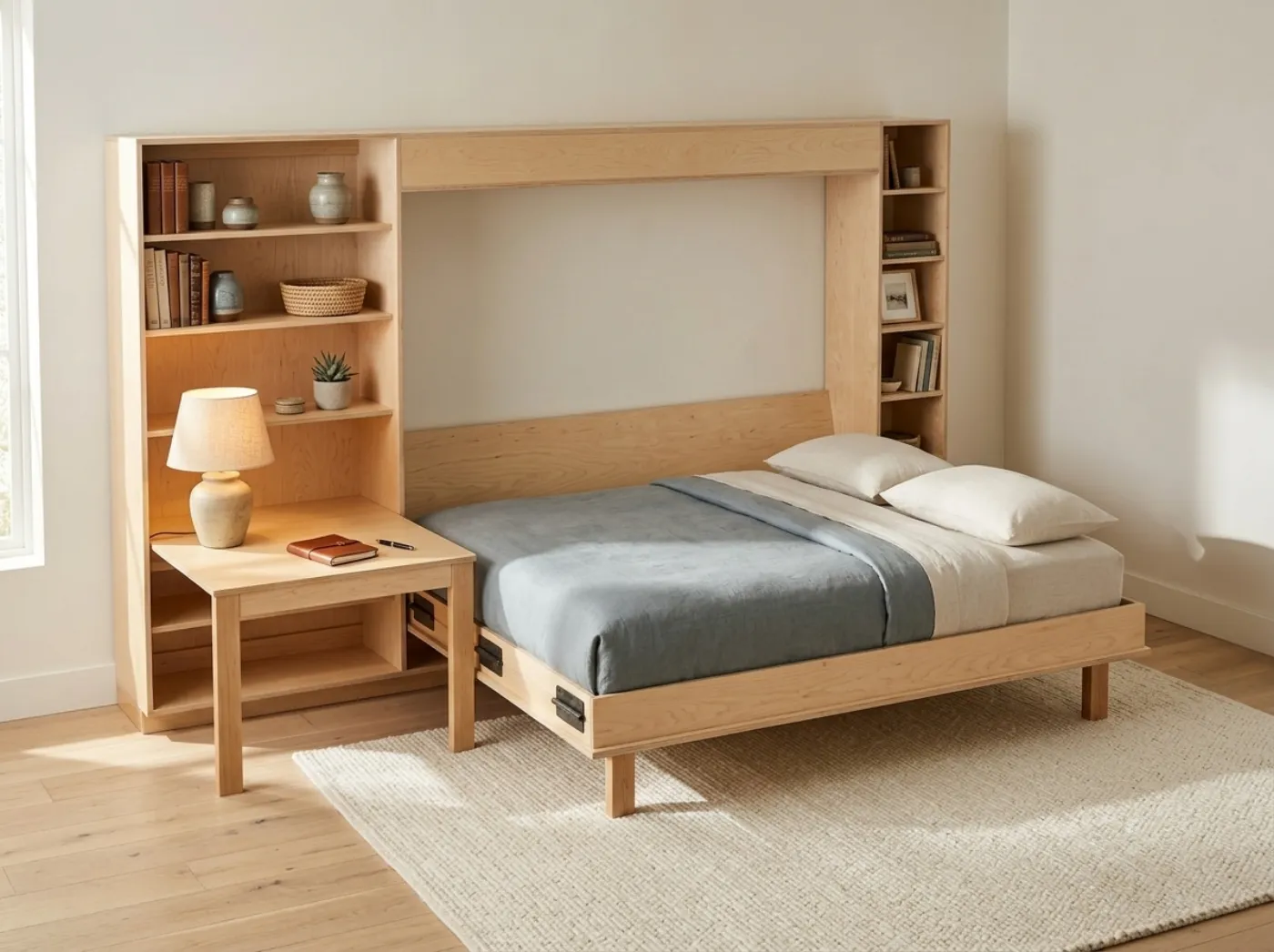
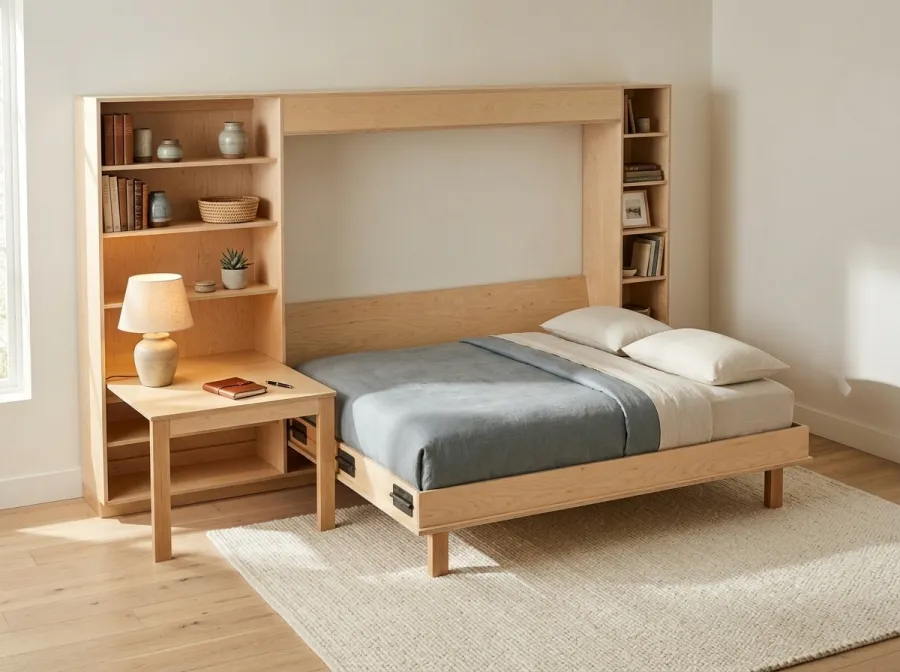
A queen-size horizontal Murphy bed with a fold-down desk and a bookcase tower on each side costs about $1,515 in materials, with a realistic range of $1,210 to $1,740 depending on your region and how you shop. A twin version runs about $1,382 and a full about $1,462. Comparable finished wall-bed units with a desk and flanking bookcases, the kind sold through catalog retailers and showrooms, typically list between $1,659 and $2,699 before delivery and installation. So the honest answer is that building is cheaper, but not always by a dramatic margin, and the gap depends heavily on where in those ranges you land.
All materials figures in this article are estimates at typical US home-center prices. They vary by region, by season, and by how much you shop around, so treat them as a planning range rather than a quote.
What the numbers actually cover
The figures here come from the computed materials list in our Library Wall Bed plans, which price every board, sheet, screw and hinge for each size. They are not a guess based on a similar project. The list covers the cabinet, the bed box, the desk, both shelf towers, all the hardware and the finish. It does not include your mattress, your tools if you do not own them, or any wall repair behind the unit.
Here is the queen breakdown, grouped and rounded:
| Category | What is in it | Estimated cost |
|---|---|---|
| Lumber | 1x3, 1x4, 2x4 and 2x6 framing boards | $220 |
| Sheet goods | Six sheets of 3/4 in plywood, five of 1/2 in plywood | $610 |
| Fasteners and glue | Construction screws, plywood screws, wood glue, wall anchoring screws | $245 |
| Hardware | Pivot hinges, lift assist, stop straps, latches, desk hinge and catches, glides, pulls | $345 |
| Finish | Edge banding, primer and cabinet paint or wipe-on polyurethane | $95 |
| Total (queen) | about $1,515 |
The twin and full sets differ mainly in lumber, plywood count and fasteners. The twin comes to roughly $184 in lumber, $564 in sheet goods, $208 in fasteners, $345 in hardware and $81 in finish. The full lands at about $209, $612, $215, $345 and $81 for the same five lines.
Two things stand out. First, plywood is the single biggest cost, around 40 percent of the total. Second, the hardware line is the same $345 across all three sizes, because the heavy pivot hinges and the lift assist are priced as a set whatever the mattress size.
Build versus buy: the fair comparison
The finished unit gives you things a DIY build does not, and they have real value.
Delivery and assembly. A finished unit arrives with the mechanism already matched to the mattress weight. Many retailers offer white-glove delivery and installation. When you build, you carry plywood, assemble in place, and you are the installer.
A tested mechanism as a package. Store versions pair the cabinet with a mechanism sold as a unit, and a warranty usually covers it. When you build from plans, you buy the hinges and lift assist separately and match them to the ratings in the plans. That is entirely doable, but responsibility for the match is yours.
Time. The plans do not promise a single-weekend build for this project. A wall bed with a desk and two towers is a cabinet-making job. Treat it as a multi-weekend project, with extra time for painting and curing.
What building gives you. You choose the wall length, the finish, the shelf layout and the paint color. You also avoid freight damage and the wait for a custom order. And at the middle of the price ranges, you keep several hundred dollars. At the top of the retail range you keep more than a thousand.
A reasonable rule: if you already own a circular saw, a drill and a few clamps, and you have a helper for lifting, building makes sense. If you would be buying every tool and you value a warranty and white-glove delivery, a finished unit may be worth the premium.
What drives the cost up or down
Plywood grade and species
The plan prices 3/4 in and 1/2 in plywood at typical home-center cabinet or sanded grade. Upgrading to birch or maple veneer plywood raises the sheet goods line noticeably, because you are buying eleven sheets. Choosing a paint-grade sheet and painting the cabinet keeps it down.
The mechanism
The lift assist is the part to buy carefully. The plans give the weights and the ratings to look for: a pair of gas pistons or spring mechanisms rated for 230 lb or more on the twin, 320 lb or more on the full, and 370 lb or more on the queen. The estimate carries $140 for the pair. A wall bed lift mechanism kit or a horizontal Murphy bed piston pair from a hardware specialist can sit above or below that figure. Do not undersize it to save money.
The pivot hinges are the other safety-critical item. The plans call for three heavy-duty steel pivot hinges rated at 500 lb each for twin and full, and 600 lb each for queen. Search for heavy duty pivot hinges 500 lb and check the rating on the listing against the plan rather than trusting the product title.
Finish
Painting is the cheapest finish and hides plywood edges well. A clear coat over birch looks richer but costs more in material and in sanding time. Either way, plywood edges that show need iron-on edge banding, and the estimate includes two or three 25 ft rolls depending on size.
Your region
Plywood and lumber prices move more by region than hardware does. The low and high ends of the range ($1,210 to $1,740 for the queen) reflect that spread. Check your local sheet price before you commit and scale the sheet goods line accordingly.
Buying in one trip
Fasteners are a bigger bill than people expect. The queen estimate has about $245 in screws, glue and anchoring. Buying screws by the box is cheaper per screw than by the handful, and coated construction screws in bulk boxes are a common place to trim cost. Wood glue adds up too: the estimate carries six or seven 16 oz bottles, and Type II wood glue in a larger container may be cheaper per ounce.
The hard parts and how the plans handle them
A Murphy bed is not a hard piece of joinery. It is a hard piece of safety, because the mechanism holds a heavy bed and the cabinet must stay attached to the wall.
The bed box and pivot. The bed is a flat plywood box hinged along its long bottom edge. Stored, it stands up behind a framed face. Lowered, it reaches 3 ft 4 in (twin), 4 ft 8 in (full) or 5 ft 2 in (queen) into the room, resting on two fold-out wooden legs under the foot. The plans give the dimensions for each size so you can check the floor space before you start.
The lift assist. Plans give the torque the lift assist must hold, along with the bed weights, so you can compare the manufacturer’s mounting chart against a real number. Stop straps limit the swing to 90 degrees, and a positive-locking latch holds the bed closed.
The desk. The desk leaf (3 ft 3 in by 2 ft 6 in) hangs from the cabinet, not the bed. That means it stays level whatever the bed does, which avoids the common failure of desks that tilt with the mattress. A continuous piano hinge, rated 300 lb or more, carries it, with folding legs and a magnetic or roller catch to hold it closed.
Wall anchoring. This is non-negotiable. The unit is tall and the bed swings out, so the cabinet must be fastened to wall studs. The estimate includes 20 stud-rated structural wood screws, one per stud crossing on both anchor rails. A stud finder helps you locate framing, and you should confirm the studs are sound before you load the wall. If your wall is masonry or has unusual framing, get qualified advice before attaching a Murphy bed. These are generic DIY plans, not engineered drawings, and they do not replace local building requirements or an inspection if your jurisdiction needs one.
Every member in the plans (deck joists, rails, pivot beam, legs, desk, wall anchors) is checked against a stated load. That is a design check built into the plans, not a certification.
Sizes and space
The closed size is 11 ft 1 in wide for twin and full, and 11 ft 6 in wide for queen, 1 ft 6 in deep and 7 ft tall. That is a big piece, and you need a clear wall at least that long. The unit is a desk tower on the left, the bed bay in the middle and a shelf tower on the right, built as one piece. The plans do not cover building the bay without the towers, so if you want only a bare cabinet bed, this is not the design.
If you have a standard 8 ft ceiling, the 7 ft height leaves room for a crown detail or simple trim. If your ceiling is lower, check before you cut.
Time, tools and skill level
The plans suit home builders comfortable with a circular saw and a drill who have a helper for lifting. You do not need a cabinet shop. A circular saw with a guide or a track, a drill, clamps, a level and a tape will carry you through most of the build. A pocket hole jig is not required but can speed up the tower assembly if you like that method. A brad nailer helps with trim and edge banding.
Plan for the work to run over several weekends. Cutting sheet goods accurately takes time, and so does finishing 11 sheets of plywood in two coats. Leave extra days at the end for paint to cure before you load the bed, because the first folds can mar a soft finish.
Whoever helps you lift should be there for the bed-box installation and the first test lowering. Do not try to hang the bed alone.
Safety notes that matter
A wall bed deserves more respect than a bookcase. Fasten the cabinet to studs, use the rated hardware, install the stop straps, and test the mechanism empty before putting a mattress on it. Keep children away from the bed while it is moving, and do not let anyone sleep on it until you have checked that the latch holds, the legs lock and the lift assist matches the loaded weight. Revisit the fasteners periodically, which the plans’ maintenance and inspection log is there for.
Is it worth building?
For a queen, the estimate range of $1,210 to $1,740 against $1,659 to $2,699 for a comparable finished unit means you are likely to save somewhere between a few hundred and well over a thousand dollars, depending on your local prices and which finished unit you would have bought. You are trading that for time, a rented or borrowed helper, and the responsibility of matching the hardware to the weight.
If that trade appeals, the cost is predictable because the plans include a materials list by size and a budget planner to track it. To see how other projects compare, the build-cost hub lists estimates side by side.
Where to go next
The Library Wall Bed plans run 98 pages for $19.99 and include twin, full and queen in one kit: design basis, drawings, pivot and lift-assist detail, a cut list for every piece, a computed materials list, and a build-day checklist. If you are weighing several projects, the complete collection bundles all of the plans for $129.
Before you buy anything, measure your wall, find your studs and read the safety and anchoring sheet in the plans. That one hour tells you whether the piece fits your room, and it is the cheapest part of the project.