How Much Does a DIY Platform Bed Cost? Build a Low Floating Bed vs Buy
A queen low platform bed costs about $510 to $730 in lumber and finish to build, against $399 to $1,799 for comparable finished solid wood platform beds.
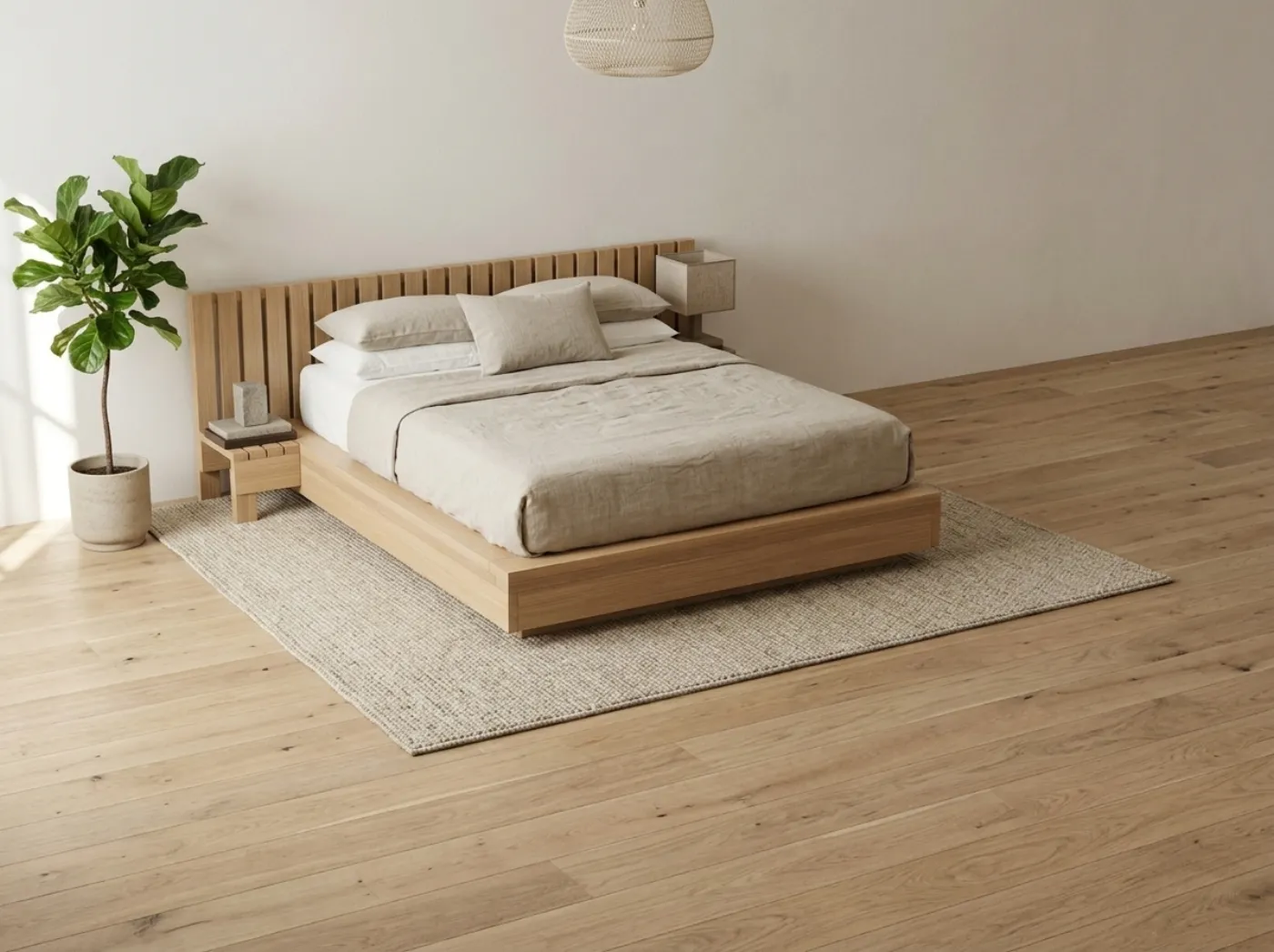
A queen-size low platform bed with a tall slatted headboard costs about $634 in materials to build, with a realistic range of $510 to $730. A twin comes to about $480, a full about $562 and a king about $712. Comparable finished solid wood platform beds from catalog retailers and showrooms run about $399 to $1,799, and that usually excludes the mattress. The honest summary: at the low end of retail, a store bed can be cheaper than building, and at the middle and upper end, building wins comfortably and gives you a real solid wood frame.
Materials estimates here are at typical US home-center prices and vary by region, so they are planning numbers and not quotes.
What you are actually building
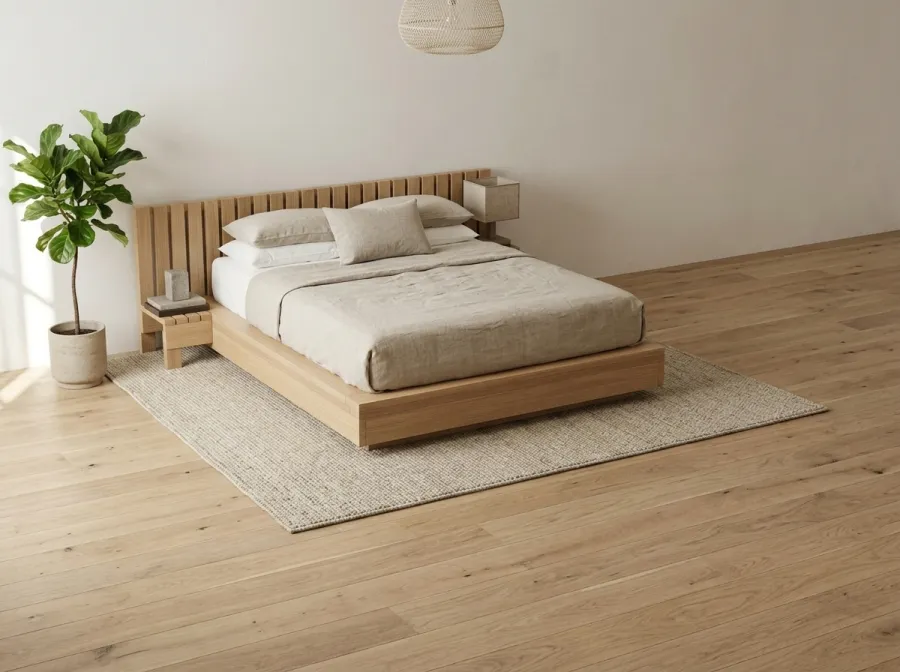
Our Low Platform Bed plans describe a low, Japanese-inspired bed that seems to hover. The deck sits about 10-1/2 in off the floor on a slatted platform, carried by a wide frame that rests on a narrow base set in 4 in, which creates the floating look. A flat ledge about 5-1/2 in wide runs around three sides, 1-1/2 in above the slats, and a tall headboard of vertical slats reaches 11 in past the bed on each side, with optional nightstand ledges at both ends. Queen, king and California king sizes add a center beam on center legs.
Every board is a standard 8 ft 2x4, 2x6 or 1x4. There is no plywood and no special hardware.
The queen cost breakdown
| Category | What is in it | Estimated cost |
|---|---|---|
| Lumber | 6 boards of 1x4, 20 of 2x4, 12 of 2x6, kiln-dried | $392 |
| Fasteners and glue | Coated #10 and #8 screws in three types, wood glue | $87 |
| Hardware | 13 felt or rubber furniture pads | $13 |
| Finish | About 7 quarts of water-based clear finish or hardwax oil, sandpaper | $142 |
| Total (queen) | about $634 |
The mattress is not included. Neither are any optional stain or wood conditioner, which the plans suggest for pine or fir if you want a light oak or ash tone.
Across sizes:
| Size | Lumber | Fasteners | Finish | Total estimate | Range |
|---|---|---|---|---|---|
| Twin | $308 | $58 | $104 | $480 | $380 to $550 |
| Full | $371 | $58 | $123 | $562 | $450 to $650 |
| Queen | $392 | $87 | $142 | $634 | $510 to $730 |
| King | $451 | $87 | $161 | $712 | $570 to $820 |
Hardware is a flat $10 to $13 for felt pads in each case. The jump from twin to king is about $230, almost all of it lumber and finish. The plans also cover California king; the table above lists the four sizes with computed estimates.
Notice the finish line. At $142 on the queen, it is more than a fifth of the budget, because a slatted headboard and a ledge have many faces and edges.
Build versus buy
What the store version gives you. A finished bed arrives ready to assemble, often with a warranty on the frame and sometimes with a slat system that ships flat. Delivery may be free. You can see the finish in a showroom. For people who sleep on the floor of a guest room twice a year, a budget frame at the low end of $399 is a perfectly rational purchase.
What the DIY version gives you. Solid lumber instead of veneered composite, a wide ledge and nightstand ledges that retail beds charge extra for, and a headboard sized to your room. The frame is thick, heavy and repairable. If you scratch it, you can sand and refinish it. Over the whole range, building a queen at $634 beats the middle of the retail range and is far below the top. At the high end, a $1,799 finished solid wood bed costs nearly three times the queen materials estimate.
What it costs in time. The plans estimate roughly 9 to 12 hours of work over a weekend, depending on size. That is real, but it is a short build next to a wall bed or a bunk bed.
What you give up. A manufacturer’s warranty, delivery, and a factory finish. The bed will also be heavy to move, because it is solid lumber, so plan where it will live.
What drives cost up or down
Wood species
The plans use kiln-dried pine, fir, poplar, ash or oak. The estimate prices boards at about $1.12 per foot for 2x4, $1.58 for 2x6 and $1.27 for 1x4, which reflects kiln-dried framing-grade or better stock. Switching to poplar, ash or oak raises the lumber line a lot, perhaps well beyond the numbers here. Stay with pine or fir and a good finish if cost matters. Choose individual boards, as straight stock matters on a long platform.
Finish
A water-based clear finish or hardwax oil in a light oak or ash tone gives the Japanese-inspired look. Pine and fir blotch with stain, so the plans suggest a wood conditioner first. The conditioner and stain are optional and are not in the estimate. If you want them, add a pre-stain wood conditioner and a light oak interior stain. A hardwax oil finish is a good low-sheen option that goes on with a rag.
Size
Each step up in size adds about $70 to $90. Building a full instead of a queen saves about $70. Building a twin for a child saves about $150 relative to a queen.
Fasteners
The plans list three screw types: #10 x 3 in for frame joints, #8 x 2-1/2 in for slats and ledges, and #8 x 1-1/4 in for the headboard. Boxes of 100 are the pack size, with two of each in the queen estimate. You will have screws left over. Compare coated wood screws in bulk if you build multiple pieces.
The hard parts and how the plans handle them
The floating base. The frame sits on a narrow base set in 4 in from the edge. That setback is what gives the shadow gap. The plans give the dimensions for each size and explain how to keep the base square. A framing square and a couple of bar clamps make assembly easier.
The center beam. Queen, king and California king need a center beam on center legs so that the slats do not sag. The plans include it in the drawings and cut list for those sizes.
The slatted headboard. Vertical slats attach to rails with #8 x 1-1/4 in screws. Spacing is the visible detail. The plans give slat widths and gaps, and the cut list for every piece, so you can set up a spacer block and repeat it.
The ledge. A flat ledge about 5-1/2 in wide runs around three sides, 1-1/2 in above the slats. It holds the mattress in place and doubles as a landing spot for a book or a phone. The mattress sits inside the ledge, so check your mattress dimensions against the plan: a queen is 60 x 80 in, a king 76 x 80 in, and the plans allow for mattresses up to 12 in thick.
Sanding. Because the bed is low and open, you will see all edges, so a good sand pays off. A random orbital sander saves hours over hand sanding the headboard slats.
The plans use numbered steps with one drawing each, a lettered parts list and a shopping list per size. They are generic DIY plans, not engineered drawings. Because this is a sleeping surface, give the finished frame a firm check before using it: confirm that every screw is driven, that slats are fastened and that the center legs sit flat.
Time, tools and skill level
This is a first-build-friendly project. The plans are written for beginners who can follow flat-pack furniture instructions. You will need a circular saw or miter saw, a drill with a driver bit, a tape, a square, clamps and sandpaper. A miter saw makes cutting the many identical slats faster and cleaner, though a circular saw with a guide will do the job. A pocket-hole jig is not part of this design.
Allow roughly 9 to 12 hours over a weekend, plus finishing time. Water-based clear finishes dry quickly, which keeps the schedule short; check the label for recoat time.
Sizes available
The plans cover twin, full, queen, king and California king, with a pick-your-size sheet that routes you to the right set. The queen is 6 ft wide and 7 ft 4-3/4 in long, with a headboard 7 ft 10 in wide and 2 ft 10 in high, for a 60 x 80 in mattress. Nightstand ledges at both ends are optional.
Choosing a mattress before you build
The estimates above stop at the frame, and the mattress is the other half of the bill. It also affects the design, because the mattress sits inside the ledge and the plans size the ledge for stated dimensions. Measure the actual mattress you plan to use, not the nominal size on the label, since foam and hybrid mattresses can differ by an inch or so. If you already own the mattress, check it against the plan before you cut. If you are buying new, consider thickness: the plans allow up to 12 in, and a very thick pillow-top will sit proud of the ledge and lose some of the low, tucked-in look. Slats need to support the mattress evenly, so follow the plans’ mattress and slats sheet for spacing rather than leaving big gaps.
A few practical notes
Low beds are comfortable for most adults, but they are lower than standard beds. If you or a guest has trouble getting up from a low seat, consider that before building. Keep the bed away from a baseboard heater or a radiator. Use the felt or rubber pads to protect hardwood floors. Check the screws once a year, which the plans’ yearly check log is for.
Is it worth building?
If you are comparing against the cheapest finished frames, a store purchase may win on price, and you should be honest with yourself about that. If you want a solid wood frame in a specific size, with a proper headboard and ledge, building is likely to be well below the cost of a comparable finished piece, and it is a short project. The build-cost hub lets you compare this against other projects before you decide.
Where to go next
The Low Platform Bed plans cost $9.99 and run 104 pages, with a cut list, numbered steps and shopping list for each size, plus a mattress and slats sheet, finishing guidance and a budget planner. If you are furnishing a whole room, the complete collection covers every plan for $129, and a console table pairs well with this bed. Pick your size and open the platform bed plans to see the full shopping list.