Bunk Bed with Stairs: DIY Cost vs Buying a Solid Wood Bunk Bed
A twin over twin bunk bed with a seven-drawer storage stair costs about $990 to $1,420 to build, or $410 to $590 with a ladder. Finished: $1,199 to $1,749.
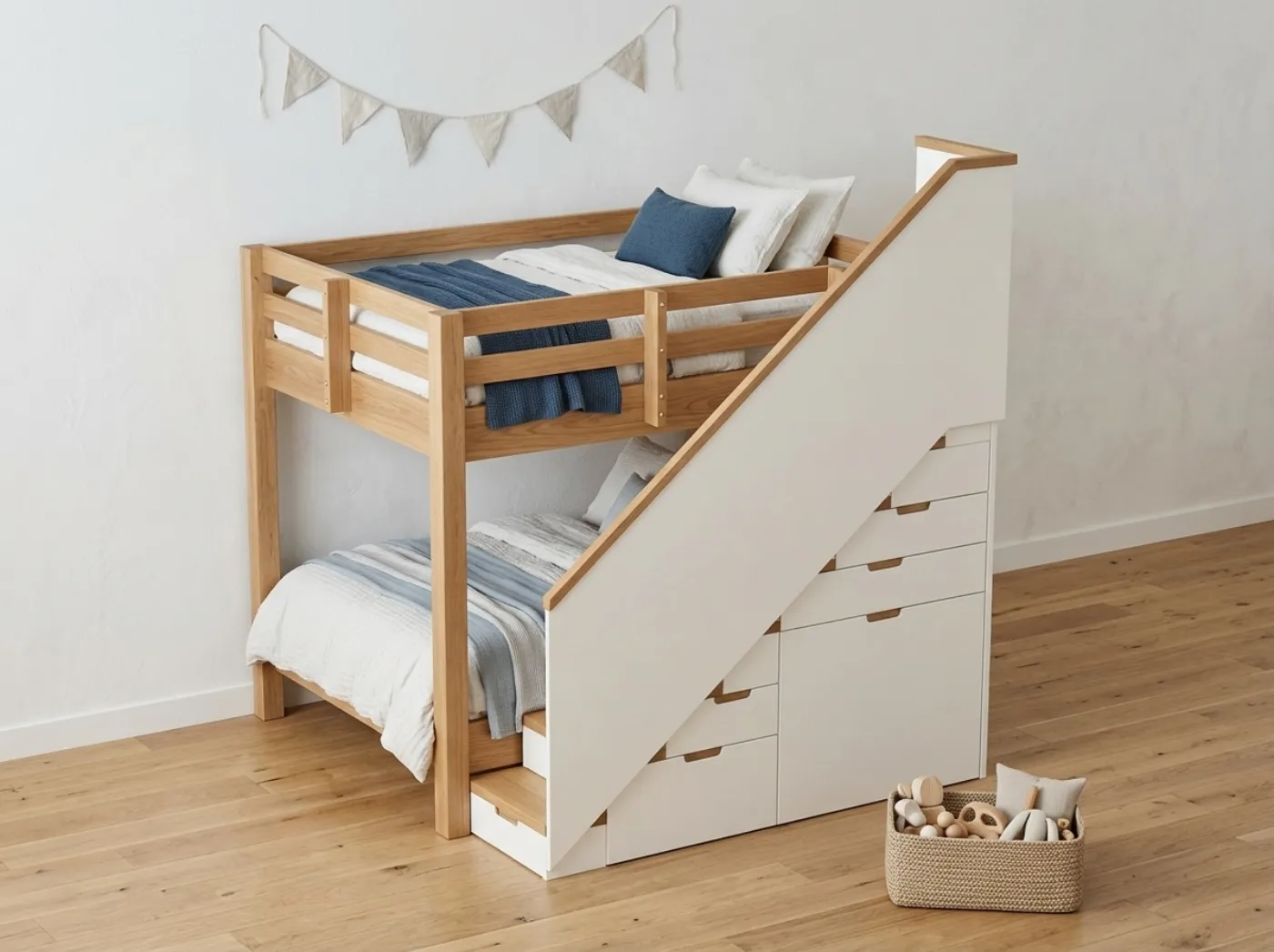
A twin over twin solid wood bunk bed with a storage staircase costs about $1,234 in materials to build, with a realistic range of $990 to $1,420. If you swap the stair for a simple ladder, the same bed drops to about $515, or $410 to $590. A twin over full bed with the stair is about $1,394, and about $675 with a ladder. Comparable finished solid wood bunk beds with storage stairs, sold through catalog retailers and showrooms, run about $1,199 to $1,749. So the stair version is roughly a wash against the cheaper end of retail, and the real savings show up if you choose the ladder.
That is a more mixed answer than most build-versus-buy articles give, and it is worth being plain about. The storage stair, with its seven drawers, plywood and slides, is the expensive part. The bed itself is not.
Materials estimates here are at typical US home-center prices and vary by region.
Where the money goes
Our Heirloom Bunk Bed plans price the bed and the access option separately, because you choose one or the other. The tables below show the twin over twin build, grouped and rounded.
The bed frame (twin over twin)
| Category | What is in it | Estimated cost |
|---|---|---|
| Lumber | 2x2, 2x4, 2x8 and 4x4 stock | $210 |
| Sheet goods | Two sheets of 3/4 in plywood for the decks | $125 |
| Fasteners and glue | Structural screws, construction screws, deck screws, wood glue | $50 |
| Wall anchors | Steel angle brackets, lag screws, screws | $35 |
| Finish | Low-odor water-based finish, sandpaper | $30 |
| Bed total | about $447 |
The access option (pick one)
| Option | What is in it | Estimated cost |
|---|---|---|
| Storage stair | Plywood (5 sheets of 3/4 in, 1 of 1/2 in, 1 of 1/4 in), seven pairs of drawer slides, pulls, brad nails, screws, tread tape, finish | $787 |
| Ladder | Two 2x4s, screws, glue, tread tape, felt pads, finish | $68 |
Inside the stair figure, plywood is about $384, drawer hardware and fasteners about $239, the stair’s own screws, tape and pads about $82, lumber about $44 and finish about $38. The drawers are the reason a stair costs more than eleven times what a ladder does.
Put together:
| Build | Estimated materials | Range |
|---|---|---|
| Twin over twin with ladder | $515 | $410 to $590 |
| Twin over twin with storage stair | $1,234 | $990 to $1,420 |
| Twin over full with ladder | $675 | $540 to $780 |
| Twin over full with storage stair | $1,394 | $1,120 to $1,610 |
The twin over full bed frame itself runs about $607 (range $490 to $700), because the lower deck is larger and needs more lumber and plywood. The stair and ladder prices are the same for both sizes.
Build versus buy, fairly
What the finished bed gives you. A finished bunk bed arrives with a tested design, a warranty and usually a label showing it meets a published safety standard. Delivery is often included. Assembly is bolt-together. If your child is on the way to bed this week, that is a real advantage. Many store versions also include the stair and drawers in the price, so you are comparing like with like at $1,199 to $1,749.
What building gives you. Solid construction from 4x4 posts, 2x8 rails and 2x4 slats, in the finish and mattress size you choose, without the particleboard or veneer that can show up in lower-priced store beds. You also set the layout, and you can pick the cheaper ladder version if storage is not important. At the ladder price, building is clearly cheaper. At the stair price, you are paying about the same as buying but getting a bigger, heavier, more customizable bed.
What building does not give you. A manufacturer’s certification or warranty. These are generic DIY plans, not engineered drawings, and the plans themselves say that local rules and standards apply. They include a Standards and local rules sheet precisely so you can check what applies to you.
What drives cost
Choosing stair or ladder
This is the whole story. The stair adds $720 over the ladder. If your family needs drawer storage, the stair is a good use of plywood. If you do not, build the ladder and put the savings toward a mattress.
Plywood
Seven sheets of plywood go into the stair and two into the bed. Sanded pine plywood costs less than birch. Because the finish is a painted or clear coat, you can choose according to look. Prices vary by region.
Drawer slides
Seven pairs of full-extension slides are about $126 of the stair cost. Look for slides rated 75 lb or more, as the plans specify. You can compare full extension drawer slides 18 inch with the ratings in the plans. Cheaper slides without a stop are not what the plans call for.
Wall anchors
The back posts are anchored to wall studs with steel angle brackets and lag screws, two per back post, one at each deck. This is about $35 and it is not a place to economize. Use a stud finder to locate framing and a heavy duty angle bracket pair of the size listed.
Finish
The plans call for a low-odor, water-based finish labeled safe for children’s furniture and toys when cured, applied in two coats, with the full cure time on the label before the bed is used. The estimate carries about $20 of finish for the bed and $19 for the stair. Look for water-based paint safe for children’s furniture and read the label for the cure time.
The hard parts and how the plans handle them
Guard rails. The top bunk has guard rails on all four sides, with every opening 3-1/4 in or less, and one 14 in entry opening. The plans specify heights relative to the mattress: the top guard rail sits 7 in above an 8 in mattress. Mattresses up to 8 in thick fit. If you buy a thicker mattress, the guard geometry changes, so choose the mattress before you build.
Posts and rails. Four 4x4 posts carry 2x8 rails, joined with 5/16 x 5 in structural wood screws, four through each post into each rail end. That is 64 screws. Plan the drilling carefully and use a pilot bit and driver set so the posts do not split. Every member (slats, rails, posts, guard, stair treads) is checked against a stated load in the plans.
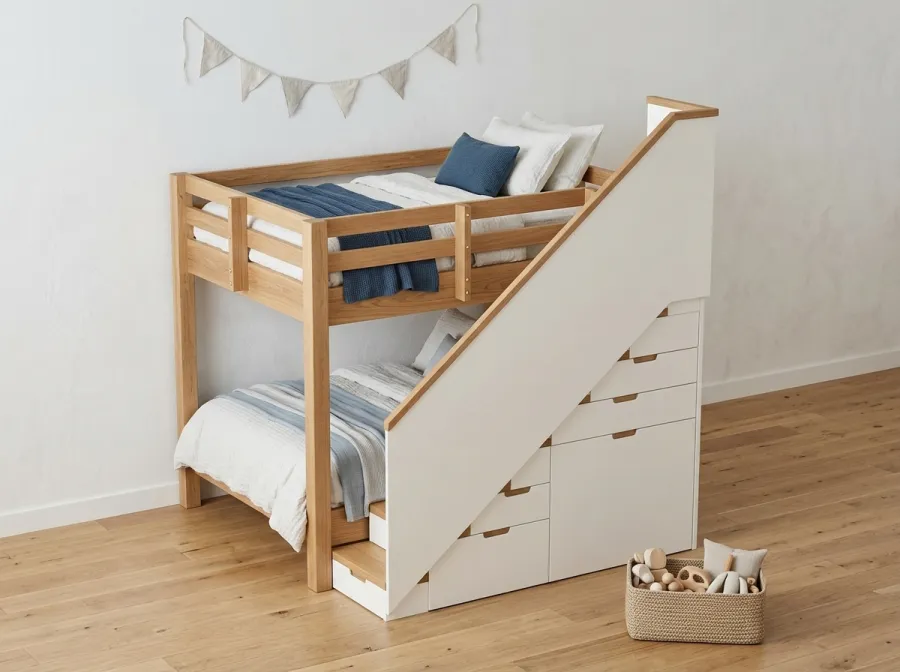
The storage stair. Eight steps with seven drawers in the risers, plus a guarded handrail side. The stair is tied to the bed through the inner side wall into the front rails with #10 x 3-1/2 in screws. It is built from plywood, and the drawers use side-mount slides. Non-slip tread tape goes on each tread. The plans include a dedicated stair and drawers set.
The ladder option. Five rungs, with tread tape on top of each rung and felt pads at the base of the rails.
Wall fixing. Bunks must be fixed to the wall. The plans include a room and wall prep sheet, and the anchors are part of the shopping list.
Room and mattress planning
Before you spend anything, decide where the bed will stand. The frame is 6 ft 1 in tall for twin over twin, so check the ceiling height, any light fixtures or ceiling fans overhead, and the distance from the top mattress to the ceiling. The back posts need to land against a wall with studs you can reach, because the wall brackets are part of the design. Think about which side the stair or ladder will face and whether a door or closet will swing into it. The twin over full version is wider at the bottom, so measure for that, too.
Buy the mattresses first, or at least settle on their thickness. The plans support mattresses up to 8 in thick, and the guard rail height is calculated from that. A thicker foam or hybrid mattress on the top bunk reduces the effective guard height, which is a safety issue and not a cosmetic one. Mattress cost is not part of the estimates above, so add it to your own budget.
Safety, plainly
A bunk bed is a piece of children’s furniture where mistakes matter. The plans state that the top bunk is for children 6 and older, one person per bunk, no horseplay, and a permanent label goes inside the top guard rail. Keep mattresses within the stated thickness. Check fasteners and anchors periodically; the plans include a maintenance and inspection log and a set of bunk bed house rules to print and post. Check your local rules and any standards that apply before you build, particularly if you are building for a child care setting or for sale, which these plans do not cover.
Time, tools and skill level
The plans are written for home builders comfortable with a circular saw, a drill and a level who want a sturdy bed with storage. You do not need a shop, but you do need space to assemble a 6 ft 1 in tall frame. You will use a circular saw, a drill, a level, clamps, a square and a brad nailer for the drawer boxes. A pocket hole jig is a useful extra if you already own one.
The plans do not give an hour count for this build. Treat the bed frame as a weekend or two of work and the stair as a similar amount again, because seven drawers take time. Paint or finish needs its full cure before use.
Sizes available
Two sizes come in one kit. Twin over twin uses twin mattresses and stands 6 ft 1 in tall. Twin over full puts a full mattress below and a twin above, with a landing strip. Each can have the storage stair or the ladder, so there are four builds from one set of plans. Mattress thickness up to 8 in is supported.
Is it worth building?
Choose the ladder and the saving is clear: roughly $515 for twin over twin against $1,199 to $1,749 finished. Choose the stair and the cost is about the same as buying, so build it because you want solid wood, a custom finish and seven real drawers, not because the numbers demand it. The build-cost hub shows how other projects compare, and some save much more per dollar than this one.
Where to go next
The Heirloom Bunk Bed plans cost $16.99 and run 105 pages. They include a plan selector, bunk bed safety rules, mattress and room fit, a standards and local rules sheet, drawings, a cut list and a materials list for each size, a build-day checklist and a budget planner. If you are building more than a bed, the complete collection covers every plan for $129. Pick your mattress, measure your room and read the safety sheet before you buy any lumber. You can start with the bunk bed plans.