Wooden Swing Set and Playhouse: Is Building It Cheaper Than Buying?
An elevated cedar playhouse with swings costs about $2,880 to $4,150 to build with safety surfacing. Finished wooden playsets run $799 to $2,499. Honest math.
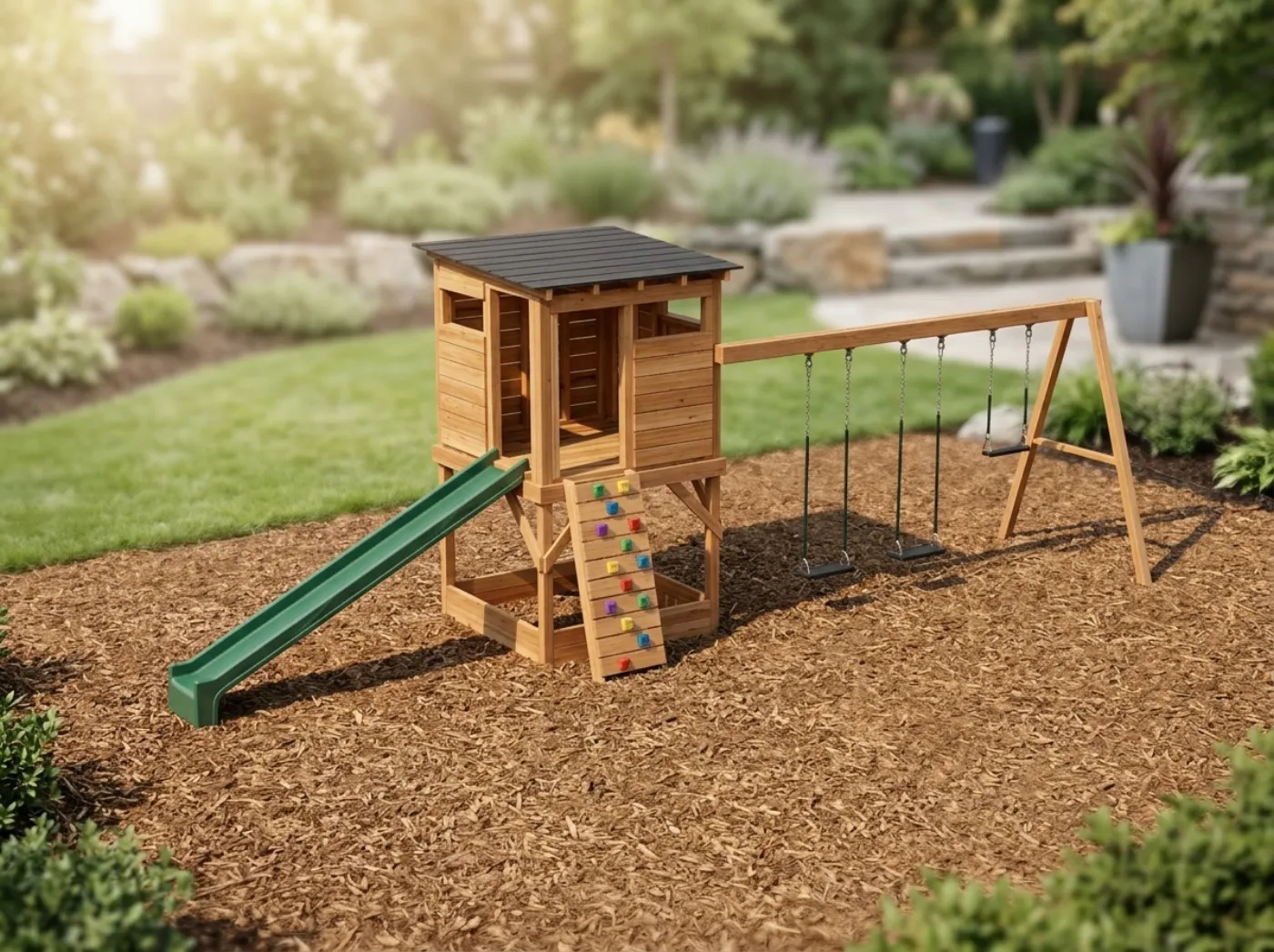
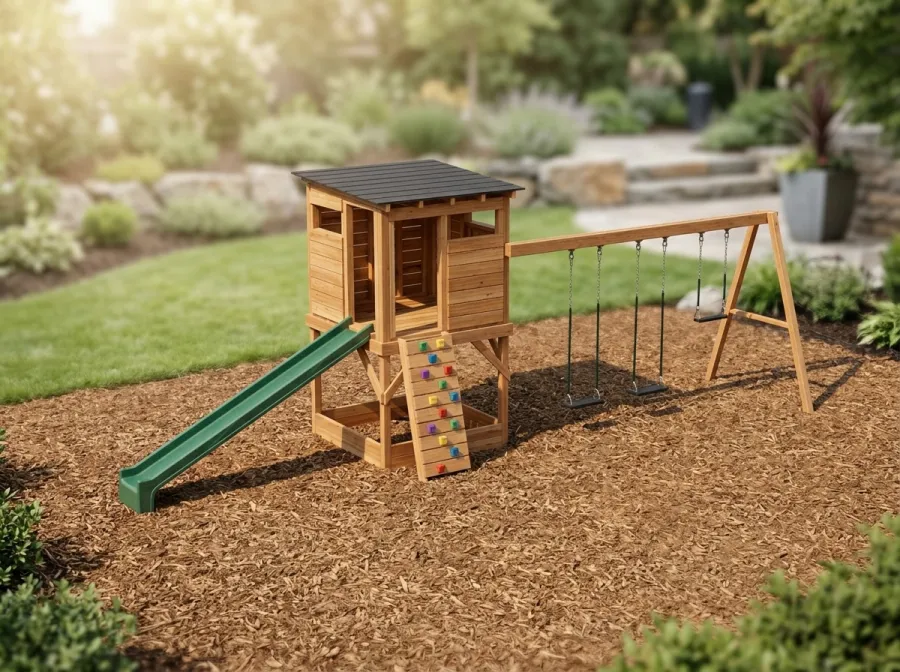
This is the one project in our set where building is usually not the cheaper option, and it is better to say so plainly. An elevated cedar playhouse with a slide, two swings and a climbing wall costs about $3,605 in materials to build, with a realistic range of $2,880 to $4,150, once you include the safety surfacing the plans call for. Without the surfacing, the materials come to about $2,321. A simpler ground-level 8x8 playhouse comes to about $3,690, or $2,950 to $4,240, and about $3,014 without surfacing. Comparable finished wooden playhouse and swing sets sold through catalog retailers and showrooms run about $799 to $2,499.
So the retail range sits below the DIY estimates in most cases. The reasons to build are the material, the design and the control you get, not a lower bill. The sections below explain where the money goes, so that you can decide with accurate numbers.
Materials estimates are at typical US home-center prices and vary by region. Lumber prices for cedar in particular swing widely.
The cost breakdown
Our Clubhouse Swing Set plans include two builds in one kit: an elevated playhouse with a slide, swings and a climbing wall, and a simple ground-level 8x8 playhouse. Here is the elevated build, grouped and rounded.
| Category | What is in it | Estimated cost |
|---|---|---|
| Lumber | 1x6, 2x4 and 2x6 cedar, redwood or kiln-dried pine, plus pressure-treated 2x6 and 4x4 for ground contact | $1,346 |
| Fasteners and glue | Exterior structural and deck screws, trim-head screws, exterior wood glue | $131 |
| Bolts | Galvanized carriage bolts and lag screws | $50 |
| Hardware and footings | Post anchors, 18 bags of concrete mix | $192 |
| Roof | Peel-and-stick membrane, drip edge, roofing nails | $52 |
| Finish | About 11 gallons of exterior oil or semi-transparent stain, sandpaper | $504 |
| Swing and climbing parts | Swing seats, hangers, rings or trapeze, climbing holds, T-nuts | $47 |
| Surfacing | About 23 cubic yards of engineered wood fiber or rubber, plus landscape fabric | $1,284 |
| Total (elevated) | about $3,605 |
The slide is not priced. The plans call for a store-bought plastic or metal playground slide, 8 ft or 10 ft depending on deck height, and the estimate leaves it out, so add it to your budget. The optional sandbox sand is not priced either.
The ground-level 8x8 playhouse breaks down differently: about $2,016 in lumber, $215 in fasteners, $30 in bolts, $64 in roofing, $684 in finish and $676 in surfacing, with small items for the site and hardware. It has no swings and no slide, but it uses more lumber because it is built from wall panels on skids.
Two numbers to compare
Because surfacing is such a large line, it helps to separate it.
| Build | With surfacing | Without surfacing | Range with surfacing |
|---|---|---|---|
| Elevated playhouse, slide and swings | $3,605 | about $2,321 | $2,880 to $4,150 |
| Ground-level 8x8 playhouse | $3,690 | about $3,014 | $2,950 to $4,240 |
When you compare against a finished set, check whether the price includes surfacing. Ask whether a finished set’s price includes it, and remember that a set on grass or hard ground is a risk for falls from height. If the finished set you are considering is priced without surfacing, the fair comparison is the “without surfacing” column against the retail price, and then you add surfacing to both. Against the top of the retail range, $2,499, the elevated build at about $2,321 is close, and the ground-level build is higher.
Build versus buy, fairly
What a finished playset offers. Delivery, a tested set of parts, a manual, usually a warranty, and often a lower price. For many families, particularly those with a deadline, a finished set is the sensible choice. The lower end of the range at $799 is difficult to beat on cost.
What the DIY version offers. A design you can adapt to your yard: a modern cedar playhouse with clean horizontal slat walls, a dutch-style doorway, a climbing wall with holds, an A-frame swing beam and an optional sandbox under the deck. You choose the wood, the stain and the placement. You control the build quality, and you can repair or modify it for years. For some families, the point is a handsome backyard structure that looks like part of the house.
Where the DIY version costs more. Cedar is expensive; the 1x6 slats alone are about $532 in the estimate. Finish is another $504, because 11 gallons of exterior oil or stain are needed for walls with many slats. And the surfacing is a big, honest cost that many people forget.
The time. About 30 hours of work for two people over two weekends for the elevated build, and about 20 hours for the 8x8. That is a serious commitment.
What drives the cost up or down
Lumber species
The plans accept cedar, redwood or kiln-dried pine for the walls, deck and trim, with pressure-treated lumber rated for ground contact where parts touch the earth. Cedar and redwood cost the most. Kiln-dried pine costs less but needs more diligent finishing. Choosing pine can cut the lumber line substantially, though by how much depends on your market.
Surfacing
Nine inches of engineered wood fiber over landscape fabric, at about $1,284, is the plan’s surfacing figure. Poured-in-place rubber costs more. Loose-fill rubber costs differently again. Bulk delivery of wood fiber by the cubic yard is generally cheaper than bagged. Check your local price.
Finish
At $504, finish is a major line. The plans call for a penetrating oil or semi-transparent stain in a cedar tone that is child-safe. Because every slat has edges, a sprayer saves time, though it requires care to keep the finish off other areas.
Concrete and anchors
Eighteen bags of 80 lb concrete mix set six post and leg footings, along with post anchors or auger-style anchors. This is a significant physical task, since 18 bags of 80 lb mix is about 1,440 lb of material to move, mix and pour. A wheelbarrow or mixing tub helps.
Swing and play parts
Swing seats, hangers, rings or a trapeze, and climbing holds are only about $47 in the estimate. Buy playground-rated parts, not general hardware. Search for playground swing seats with chain, heavy duty swing hangers and climbing wall holds with T-nuts, and check the rating on each listing against the plans.
The hard parts and how the plans handle them
Height and falls. The deck is 5 ft off the ground, a 5 ft by 5 ft clear deck on four 4x4 posts. Solid walls 40 in tall guard every open side, and the only openings are two 24 in doorways. The plans include a Safety and use zone sheet, which explains the clear space around the structure, and a slide and swing sheet with a table that matches deck height to slide length.
Footings. Post anchors and concrete footings hold the structure to the ground. Dig carefully, check for buried utilities before you dig, and keep posts plumb.
The swing beam. An attached A-frame beam carries two swings and one trapeze or rings position, with through-bolts and bolt-through hangers. The beam is where loads concentrate. Follow the plans’ bolts and spans exactly.
Ground contact. Pressure-treated lumber rated for ground contact goes wherever wood touches soil or concrete. Do not substitute interior or above-ground stock.
Inspection. A playset needs regular checking. The plans include a monthly inspection log. Tighten bolts, check for splinters and look for rot or loose parts.
Honest limits. These are generic DIY plans, not engineered drawings. Playground equipment carries risk, and the plans cannot replace supervision, age-appropriate use and local building or permit rules. Check whether your area requires a permit for a structure of this height, and consider your homeowner’s insurance.
Time, tools and skill level
The plans are written for first-time builders who can follow flat-pack instructions, with numbered steps, one drawing each, a lettered parts list and a cut list. Even so, this is a large project with heavy parts, a lot of drilling and a tall structure. Work with a second adult. You will need a circular saw or miter saw, a drill with a long bit for carriage bolts, a level, clamps, a post-hole digger or auger and a ladder. A corded drill handles the long bolt holes better than a small cordless driver. A paint sprayer for stain or a pad applicator speeds up finishing.
Sizes available
The elevated playhouse is 5 ft 7 in square at the posts with walls 9 ft 9 in high, with a slide, swings and a climbing wall. The 8x8 version is a ground-level playhouse on skids, 8 ft 1 in square, with no swing, built from the same wall panels.
Choosing between the two builds
The elevated playhouse is the better choice for children who want to climb, swing and slide, and who are old enough to use a 5 ft deck safely. The ground-level 8x8 is the better choice for younger children, for a quiet reading or play house, or for a yard with limited space or no appetite for a tall structure. It has no swing, no slide and no fall height. Think about who will use it in five years as well as today, and whether you would rather add features later than live with the limits of a small build.
Staging the work and the budget
A project of this size is easier when you split it into stages: footings and posts, then deck and frame, then walls and roof, then swing beam and climbing wall, then finish and surfacing. Buy lumber stage by stage if you can, since cedar left stacked in the sun can warp. Stain parts before assembly where you can, because slats are much easier to coat flat than on a finished wall. Delay the surfacing until the structure is finished and inspected, but do not skip it. Keeping a running tally against the budget planner in the plans helps you notice when a stage runs over, so that you can adjust the next one.
Is it worth building?
Build it if you want a cedar playhouse that suits your yard, you have a second adult and the time, and you accept that you may spend more than the middle of the retail range. Buy a finished set if you want the lowest cost, a warranty or a quick installation. Either way, budget for surfacing. The build-cost hub lets you compare this against projects where the savings are clearer.
Where to go next
The Clubhouse Swing Set plans cost $16.99 and run 97 pages. They include a build chooser, a safety and use zone sheet, a slide and swing sheet, a cut list and numbered steps for each build, a shopping list, finishing guidance, a monthly inspection log and a budget planner. If you are weighing several projects, the complete collection bundles every plan for $129. Start by reading the safety sheet and pricing your surfacing, and then open the swing set plans to decide.